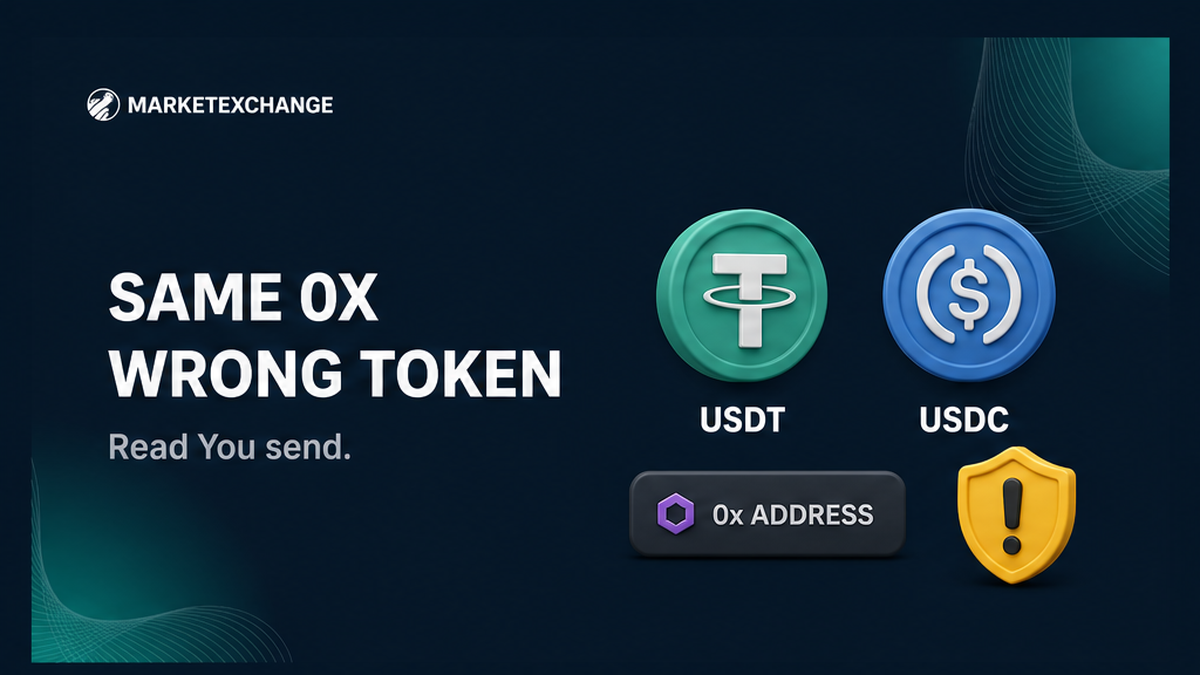

Sending USDC to a USDT deposit order can look safe when both assets use a 0x address and the wallet shows Ethereum. It is not: an ERC-20 transfer follows the selected token contract. Before broadcasting, read You send, verify the official contract, match the network, check the deposit address, and send the order amount once.
Summary: A 0x address does not identify USDT or USDC, and Ethereum will not normally reject the wrong ERC-20 token. For a USDTERC20 to USDCERC20 order, send USDT from the official Ethereum contract to that order’s deposit address. If USDC was sent instead, stop and contact official support with the Order ID, TxID, network, and token contract.
Checklist: Read the order ticker before you copy any address
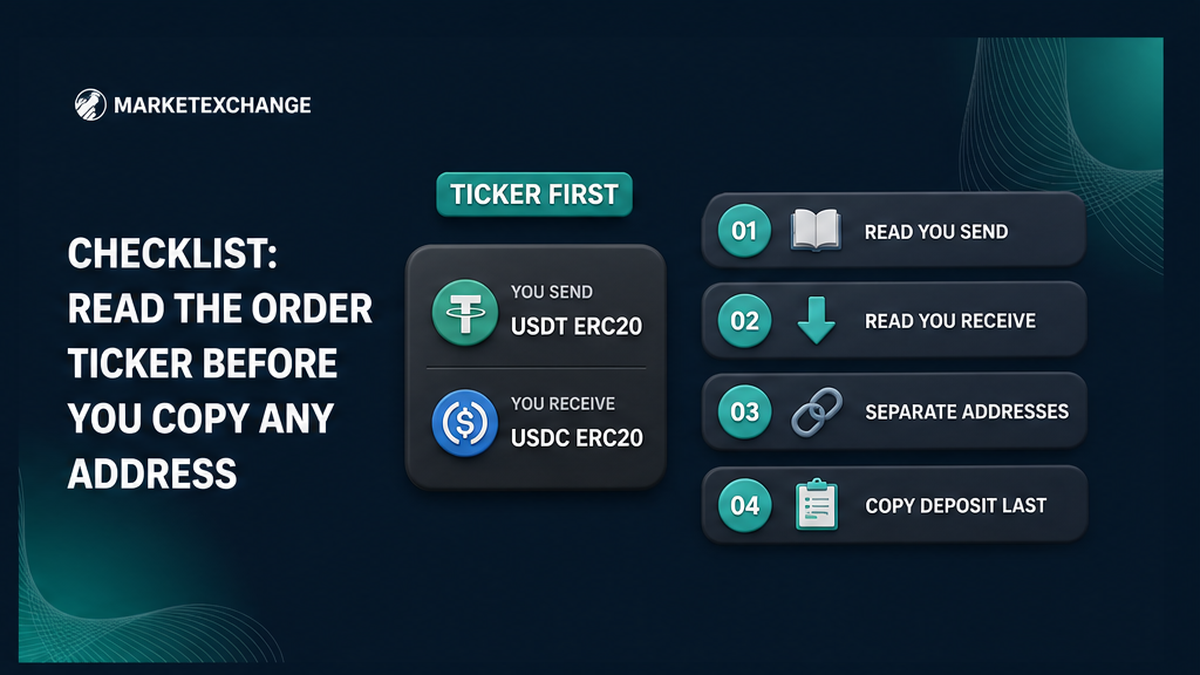
Write down the exact You send ticker and network before opening your wallet. If the order is USDTERC20 to USDCERC20, the payment is USDT on Ethereum. USDC is the output asset.
- Read You send and identify the ticker.
- Read the network beside it, such as ERC20 or Ethereum.
- Read You receive and confirm the output asset.
- Separate the payout address from this order’s deposit address.
- Confirm the order type and exact payment amount.
- Copy the current order’s deposit address only after these checks.
The direction is: You send USDT ERC20 → MarketExchange deposit address → You receive USDC ERC20 at your recipient address. Do not paste the recipient address into the sending screen or pay the token contract. A deposit address belongs to the order; a token contract identifies the asset.
Compare: Choose the token by its contract, not its similar name
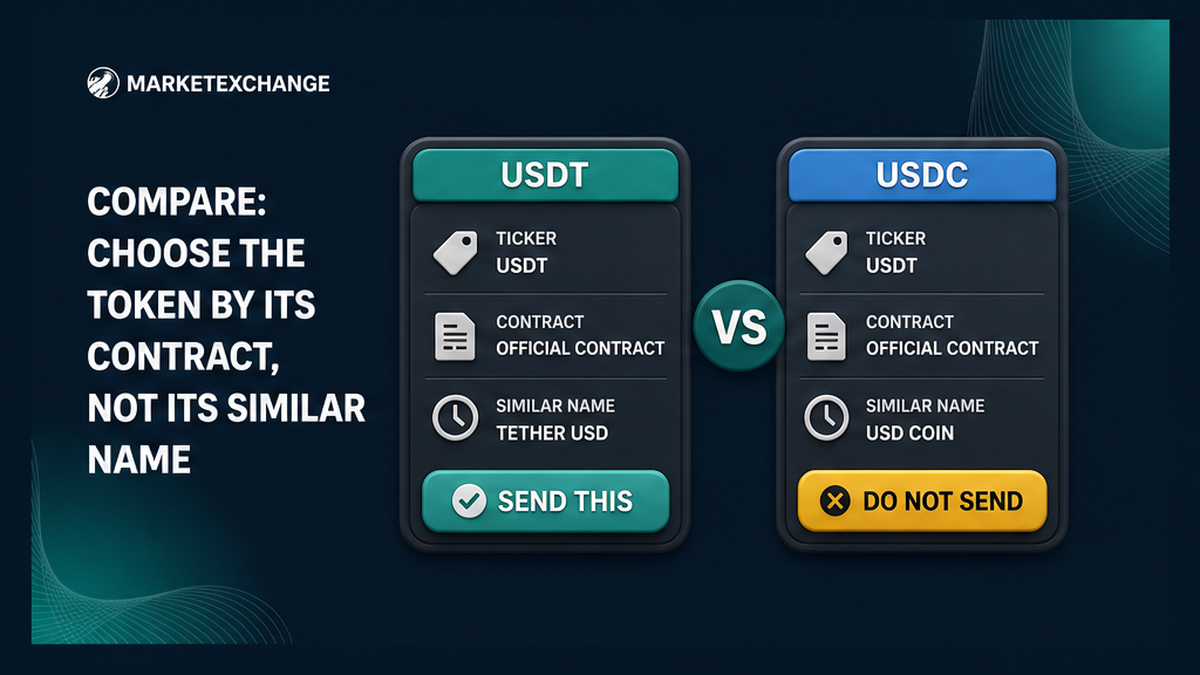
Verify the token contract for the exact chain before signing. The official Ethereum USDT contract published by Tether is:
USDT Ethereum: 0xdAC17F958D2ee523a2206206994597C13D831ec7
The official Ethereum USDC contract published by Circle is:
USDC Ethereum: 0xA0b86991c6218b36c1d19D4a2e9Eb0cE3606eB48
These are different contracts. Both assets are dollar-denominated, use the 0x format on Ethereum, and have six on-chain decimals there. They are not interchangeable.
| Order says You send | Ethereum contract to verify | Other contract |
|---|---|---|
| USDT ERC20 | 0xdAC17F958D2ee523a2206206994597C13D831ec7 | 0xA0b86991… is USDC |
| USDC ERC20 | 0xA0b86991c6218b36c1d19D4a2e9Eb0cE3606eB48 | 0xdAC17F… is USDT |
Do not select the first wallet result named “USDT” or “USDC”. Wallet search is not an authoritative issuer list. Open token details and compare the full address with official issuer documentation; if needed, use the wallet’s normal custom-token feature.
Contract rule: if the order expects USDT and the wallet contract is USDC, do not send. The reverse is also true.
Checklist: Match the network after the token is correct
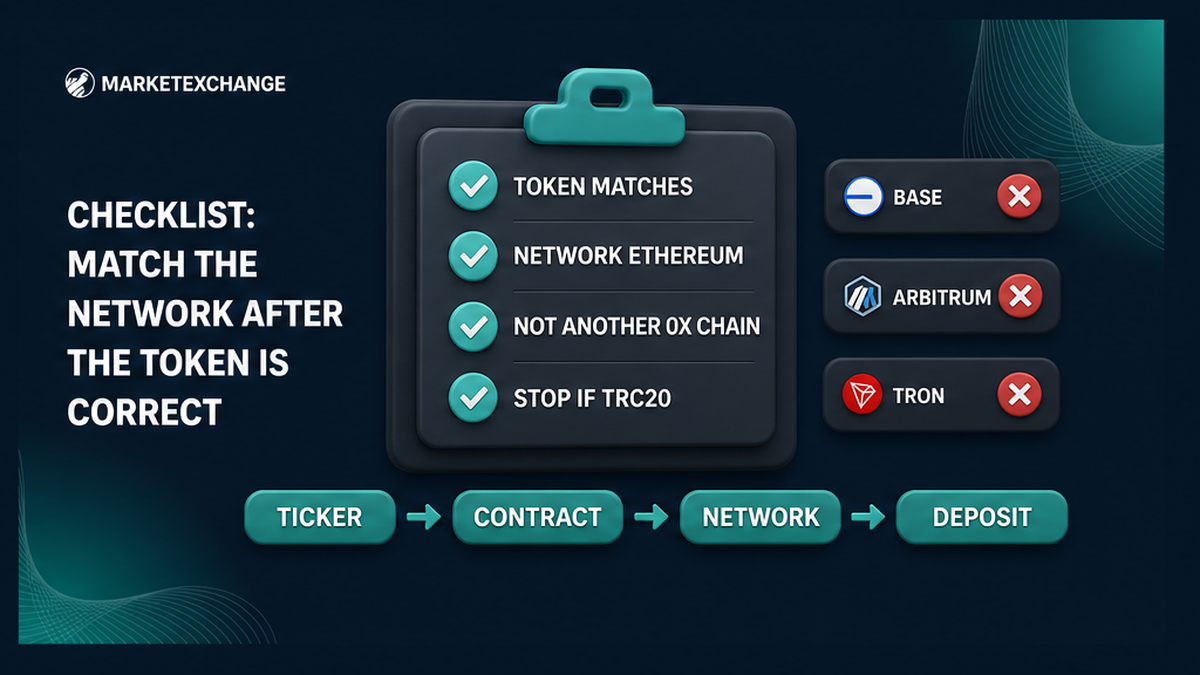
For the example order, the network is Ethereum, commonly shown as ERC20. The wallet’s sending network must also be Ethereum.
A 0x shape does not prove that every 0x-compatible network is acceptable. Ethereum, Base, Arbitrum, Optimism, Polygon, and BNB Smart Chain can use 0x addresses, while contracts and supported assets differ by network. Circle publishes different USDC contracts for different networks.
Use this sequence: order ticker → token contract → wallet network → order deposit address → amount → broadcast. Do not choose another chain unless the live order names that same network and asset. If the order says TRC20, stop using this Ethereum ERC20 checklist.
Step: Check the deposit address and send one test-sized payment
Copy the deposit address from the current order and compare every character. Confirm that it is not your payout address, a previous order, or a token contract. An ERC-20 transfer can be technically valid even when the service expected another token.
- Open the live order and read You send.
- Confirm that the wallet ticker matches the sending ticker.
- Compare the full token contract with the official contract.
- Confirm that the wallet network exactly matches the order network.
- Compare the deposit address and ensure it is not a token contract.
- Check the amount and available network fee balance.
- Review token, contract, network, destination, and amount on the wallet screen.
- Send one transaction for the order amount and keep the TxID.
A small test may reduce copying or network risk for a large payment only when current order instructions and support guidance allow it. Do not assume that a test followed by the remainder preserves a Fixed rate. MarketExchange Terms state that a wrong amount, late payment, or multiple transactions can lead to recalculation, a refund minus applicable costs, or rejection where processing is technically impossible.
The safest default is one correct token, one correct network, one correct deposit address, and one payment of the order amount. Save the Order ID and TxID after sending. Use the guide on how to find and check a crypto transaction ID if needed.
Guide: Stop after a wrong-token send and contact official support
If you sent USDC to a USDT order, USDT to a USDC order, or another unsupported token, stop immediately. Open the official MarketExchange support page and provide the Order ID, TxID, sending address, destination address, network, token contract, token symbol, amount, and a short description of the mismatch.
An ERC-20 transfer moves the selected token contract’s value to the destination. Ethereum does not generally know that MarketExchange was waiting for another ticker, so the chain may accept the transaction even when the order cannot automatically credit it. Do not ask support to treat USDC as USDT 1:1.
Do not send funds to the Tether or Circle token contract as a recovery attempt. Never provide a seed phrase, private key, wallet password, or remote-access permission.
MarketExchange Terms state that users are responsible for the wallet, network, address, and other transaction details. Recovery, where technically possible, may carry additional costs. Use only official support channels, including the website’s support page and its listed contact details. If using Telegram, verify the official link from the website: MarketExchange official Telegram.
State the error plainly: “Order expects USDT ERC20, but I sent USDC,” or “Order expects USDC ERC20, but I sent USDT.” Include the explorer link or TxID and the real contract from the explorer, not only the wallet display name. If the transaction is pending, do not replace it without official instructions.
For a correct deposit, MarketExchange Terms describe processing within 30 minutes to 72 hours. This is not a promise that a wrong-token deposit will be credited or recovered; that requires separate technical review.
Checklist: Use the final pre-send workflow on every 0x order
Run this workflow immediately before confirming the transaction, especially when USDT and USDC are both visible in the same wallet. Do not rely on memory, a default network, or a previous transaction.
| Check | Correct action | Stop condition |
|---|---|---|
| Order direction | Read You send and You receive | You select the receive asset |
| Token identity | Compare the wallet contract with the official issuer contract | Ticker or full contract does not match |
| Network | Match the wallet network to the order | You choose another 0x-compatible chain |
| Deposit address | Use the current order’s deposit address | It is a payout address, old address, or token contract |
| Amount | Enter the order amount once | You plan a second payment without guidance |
| Evidence | Save Order ID and TxID | You cannot identify the token or network sent |
Read You send → verify the token contract → match the network → copy the order deposit address → confirm the amount → send once → keep the TxID.
If any item fails, do not broadcast. Return to the order page, reopen token details, or ask official support before moving funds. When creating a new swap, use the MarketExchange exchange widget and treat its live fields as the source for the ticker, network, amount, and deposit address.
Frequently asked questions
Will the chain reject the wrong token automatically?
Usually, no. An ERC-20 transfer operates through the selected token contract. Ethereum does not generally know that the order expected another ticker.
Can support credit USDC as USDT?
Do not assume that it can. USDC and USDT are separate contracts, even when both use Ethereum, a 0x address, and six decimals. Contact official support with the Order ID, TxID, network, and contract. Any outcome depends on technical review.
Should I send USDT again after sending USDC by mistake?
No. Record the transaction details and contact official MarketExchange support.
Is a 0x address proof that the order accepts both tokens?
No. A 0x prefix identifies an address format, not a token. Verify the ticker, full contract, and network. A valid Ethereum address can receive different ERC-20 tokens while the order supports only the specified asset.
What if my wallet shows only USDT or USDC by name?
Open token details and compare the full contract with the issuer’s official documentation. If necessary, use the wallet’s standard custom-token feature with the verified contract. Do not trust a similar name, unsolicited token, or airdrop message.
What information should I send after a wrong-token transfer?
Send the Order ID, TxID or explorer link, token symbol, full token contract, network, amount, sending address, destination address, and a short description. Use only official support channels. Never share a seed phrase, private key, password, or remote-access code.
Disclaimer: The material in this article is not financial or investment advice. Everything stated here reflects the author's personal view and should not be treated as a recommendation to trade or invest. We make no warranties regarding the accuracy, reliability or completeness of the information presented. Cryptocurrency markets are highly volatile and can move unpredictably. Before committing any funds, every investor, trader or crypto user should study several independent sources and check the regulations that apply in their own jurisdiction.