
Crypto AML results can look alarming when a wallet shows a percentage, several labels, and a review warning. Do not treat one number as an automatic verdict, and do not pay anyone who promises to “unlock” a swap. Read the MarketExchange result in order: confirm what was checked, inspect labels, assess context, compare the platform guidance, and get a clear operator decision before sending.
Summary: An AML risk score is a screening signal, not a legal verdict or the whole decision. Read pause-class labels before the percentage, then check whether exposure is direct or indirect, recent or old, repeated or one-off, and material or minor. MarketExchange has separate 40% and 50% statements, so use the conservative path and ask the operator before creating an exchange.
If you have not requested a pre-swap review, use the official MarketExchange AML check page rather than a random checker. The free consultation can use a public address or TXID, together with the asset and exact network. A low or medium result does not permanently prove that funds are clean, while a high result does not by itself prove illegal activity.
Step 1. Confirm what was checked
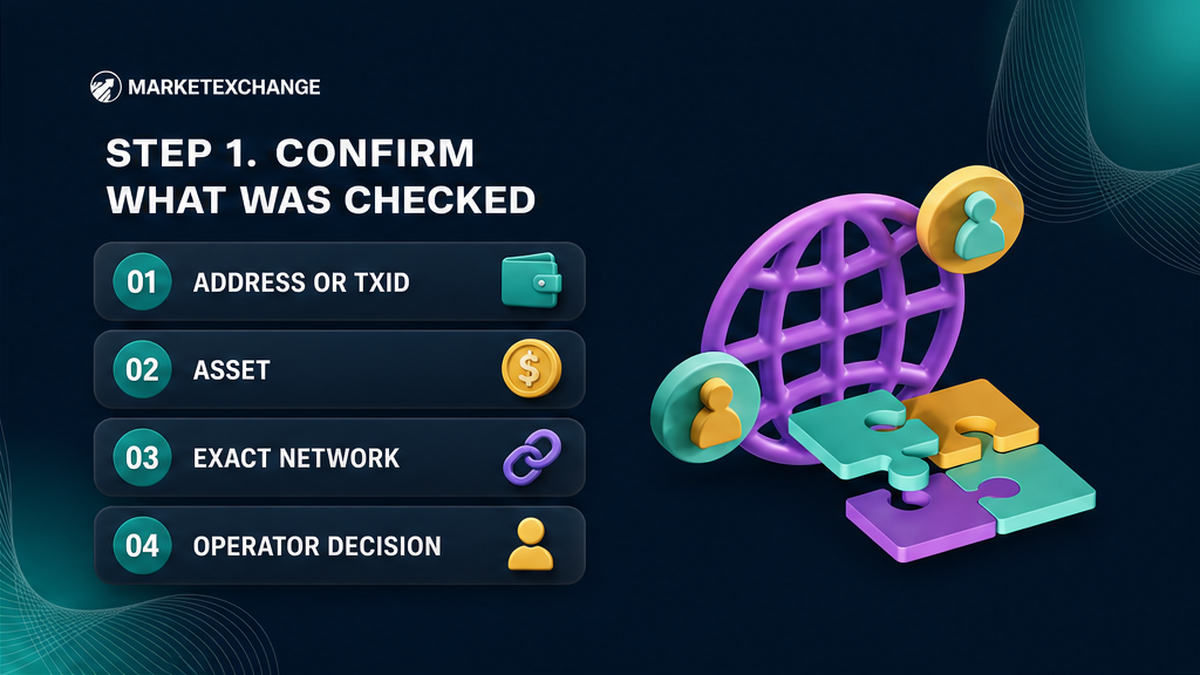
Open the existing conversation in the official MarketExchange channel and confirm that the result concerns the exact address or TXID, asset, and network you plan to use. Network matters because one ticker can exist on different chains, so a USDT check must distinguish the selected network, such as TRC20 or ERC20. Identify whether the result is a wallet screen, transaction screen, or platform decision. MarketExchange materials identify AMLBot and Elliptic on the check page, while the AML Policy also names TRM Ecosystem.
Do: Confirm the same address or TXID, asset, exact network, labels, exposure context, percentage, and operator decision. Do not: change networks, move funds, or create a draft order just to see whether a warning disappears. A pre-check is a consultation for this platform, not a permanent certificate for every later transaction.
How to read labels before the percentage
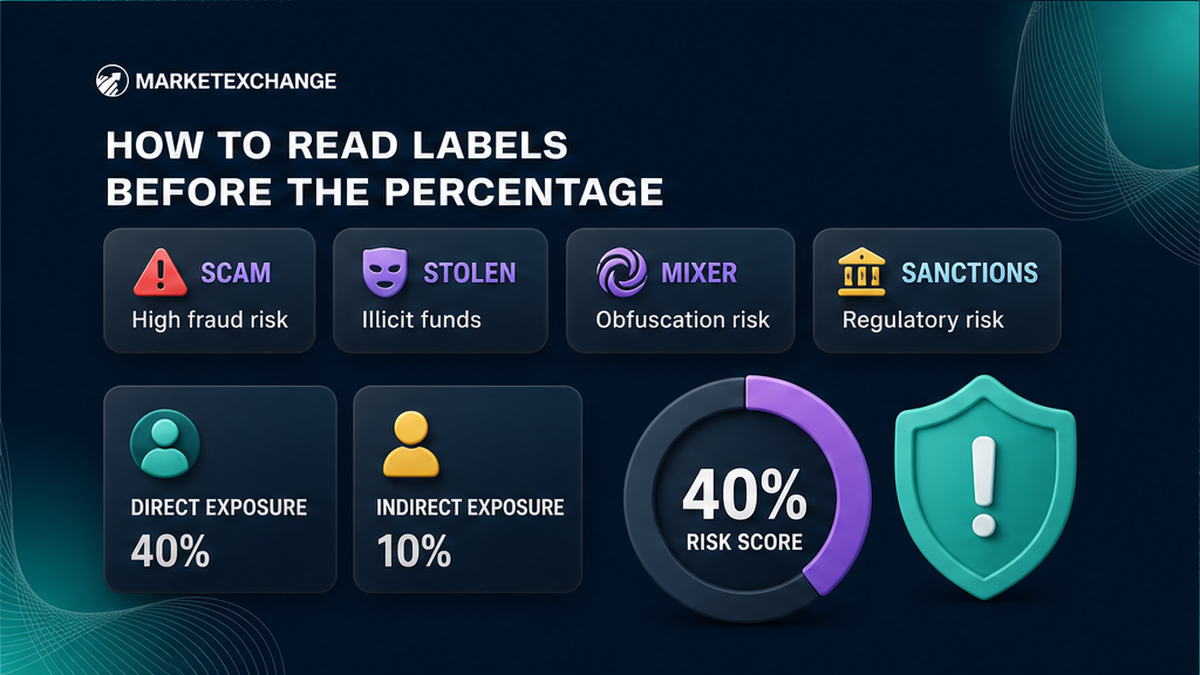
The MarketExchange AML Check page lists categories including DARK SERVICE, SCAM, STOLEN, MIXING / MIXER, SEXTORTION, RANSOMWARE, HACK, PHISHING, TERRORISM FINANCING, FRAUD, BLACKLIST, STILL UNDER INVESTIGATION, CYBERCRIME ORGANIZATION, NARCOTICS, CHILD ABUSE, HUMAN TRAFFICKING, SANCTIONS, and Protocol Privacy. The AML Policy separately includes listed labels such as GAMBLING. The lists are not identical, so treat a listed label on either current policy page as a reason to pause and ask what it means for this specific swap.
- Pause when a serious listed label appears, regardless of the percentage.
- Ask whether exposure is direct or indirect.
- Ask whether the event is recent or old.
- Ask whether the activity is repeated or one-off.
- Ask whether the label requires review, KYC, or refusal.
Do: Read the category and its context before “Low”, “Medium”, or “High”. Do not: copy score bands from AMLBot, GetBlock, or another checker and present them as MarketExchange thresholds. External educational pages do not replace the MarketExchange AML Policy or the operator’s decision.
3. Compare the 40% and 50% guidance
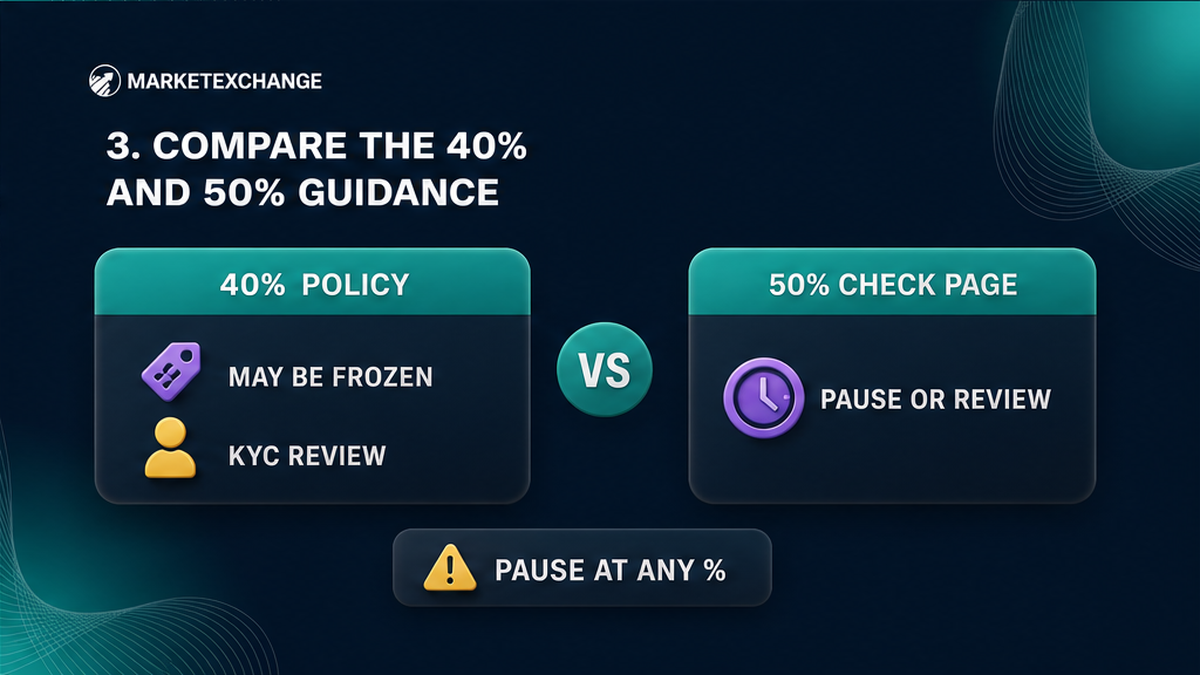
Keep both official thresholds visible because they use different wording. The MarketExchange AML Check page says to pause when listed labels appear or the overall risk is above 50%. The AML Policy says a transaction with risk higher than 40%, or a listed label, may be frozen indefinitely until full KYC. Therefore, above 40% means possible review, above 50% means the AML Check page calls for a pause, and a listed label remains a pause signal at any percentage.
| Result pattern | Conservative action |
|---|---|
| Listed pause-class label | Stop and ask the operator, regardless of the percentage. |
| Overall risk above 50% | Expect a pause or additional review under the AML Check page. |
| Overall risk higher than 40% | Allow for review or KYC under the AML Policy. |
| Below both figures with no pause-class label | Confirm the current platform decision before sending. |
Do: Compare the current MarketExchange AML Policy with the AML Check page. Do not: assume 49% is always safe or that 39% can never be reviewed. AML/KYC checks are mandatory, and a pre-check cannot guarantee the final outcome.
Checklist: check exposure, recurrence, and freshness
MarketExchange guidance highlights the share of potentially “dirty” funds, recurrence, and label freshness. Ask whether the reported share is tied to direct funds, an indirect hop, or broader wallet history. A percentage may describe the portion of screened exposure associated with risk signals, not a claim that every unit in the wallet has the same history. Then check whether similar events recur and whether the relevant label or event is recent or old. These details help the operator interpret the result, but they do not erase a serious listed label.
- Record the reported share of risky or potentially dirty funds.
- Mark the exposure as direct, indirect, or unclear.
- Check whether similar events recur in the wallet history.
- Record the date or age of the relevant label.
- Ask which factors control the MarketExchange decision.
Do: Ask for the date of the relevant label or event and whether it remains active in the provider’s data. Do not: use “it was only one transaction” as a universal excuse or assume every historical link makes a wallet unusable forever. Consider category, share, recurrence, freshness, and platform policy together.
When to pause, ask, or proceed
Choose pause when a listed high-priority label appears, the percentage is above a relevant threshold, or the report is contradictory. Choose ask when the score is medium, context is incomplete, the result comes from an external checker, or the 40% and 50% wording leaves doubt. Choose proceed only after the official operator clearly approves this asset, network, address or TXID, and intended swap. “Proceed” means you have current platform information, not that the transaction can never be reviewed.
Do: Ask, “Does this address and network pass your current AML review for this intended swap?” Live Chat can be contacted before creating an exchange to ask about the probability of blocking. Do not: use an outside score as either a veto against the operator or permission to ignore the operator. If support is unclear, pause the swap.
Avoid fake unlock fees and unsafe requests
The MarketExchange pre-check is free. Use official support routes and provide only the public address or TXID, asset, and exact network needed for review. A legitimate public-address screening flow does not require a wallet connection, private key, seed phrase, signature, approval, or transfer to the checker. Fake AML pages may show a progress bar and then request a “verification”, “unlock”, or “cleaning” payment. Do not connect a wallet, sign a transaction, send funds to “wash” the balance, or pay a stranger to release a score.
MarketExchange’s Policy may describe an extra commission of up to 5%, not more than $100 USD, for high-risk label transactions. This language is not permission to send extra crypto to a person in a private chat. Verify any fee or next step in official documentation and support. Use the official MarketExchange support route and verify claims through the website. The official Telegram channel is MarketExchange on Telegram.
Do: Save the official chat and report details, and follow only a verified process if KYC or more information is requested. Do not: move funds to another wallet or send a test amount to make the result look better.
Before sending, confirm:
- The correct address or TXID was checked.
- The asset and exact network are correct.
- Any listed pause-class labels are understood.
- Exposure is classified as direct or indirect.
- Activity is understood as recent, old, repeated, or one-off.
- The result has been compared with 40% and 50% guidance.
- The operator has clearly said whether this swap can proceed.
Frequently asked questions
Is an AML risk percentage a legal verdict?
No. It is a screening signal. A high result does not by itself prove illegal activity, and a low result is not permanent proof that funds will never be reviewed.
Should labels or the percentage be read first?
Read labels first. A serious listed label can be a pause signal even when the percentage looks moderate. Then review share, direct or indirect exposure, recurrence, freshness, and the overall percentage.
What does a risk higher than 40% mean?
The MarketExchange AML Policy says a transaction with risk higher than 40%, or a listed label, may be frozen indefinitely until full KYC. This indicates possible review and is not wording for automatic rejection.
What does risk above 50% mean?
The MarketExchange AML Check page says to pause when overall risk is above 50% or listed labels appear. Do not send before asking the operator for the current decision.
Can I pay to unlock or clean a result?
No. Do not send crypto to a stranger, connect a wallet, reveal a seed phrase, or sign an approval to clear a score. Verify every genuine next step through the official MarketExchange site and support conversation.
What should I send for a pre-swap review?
Use the official AML check route and provide the public address or TXID, asset, and exact network requested. Never provide a private key or seed phrase.
When in doubt, pause and ask before sending. The safest interpretation is the clearest current MarketExchange decision for the exact asset, network, address or transaction you intend to swap.